
Cement
And what really holds things together at work

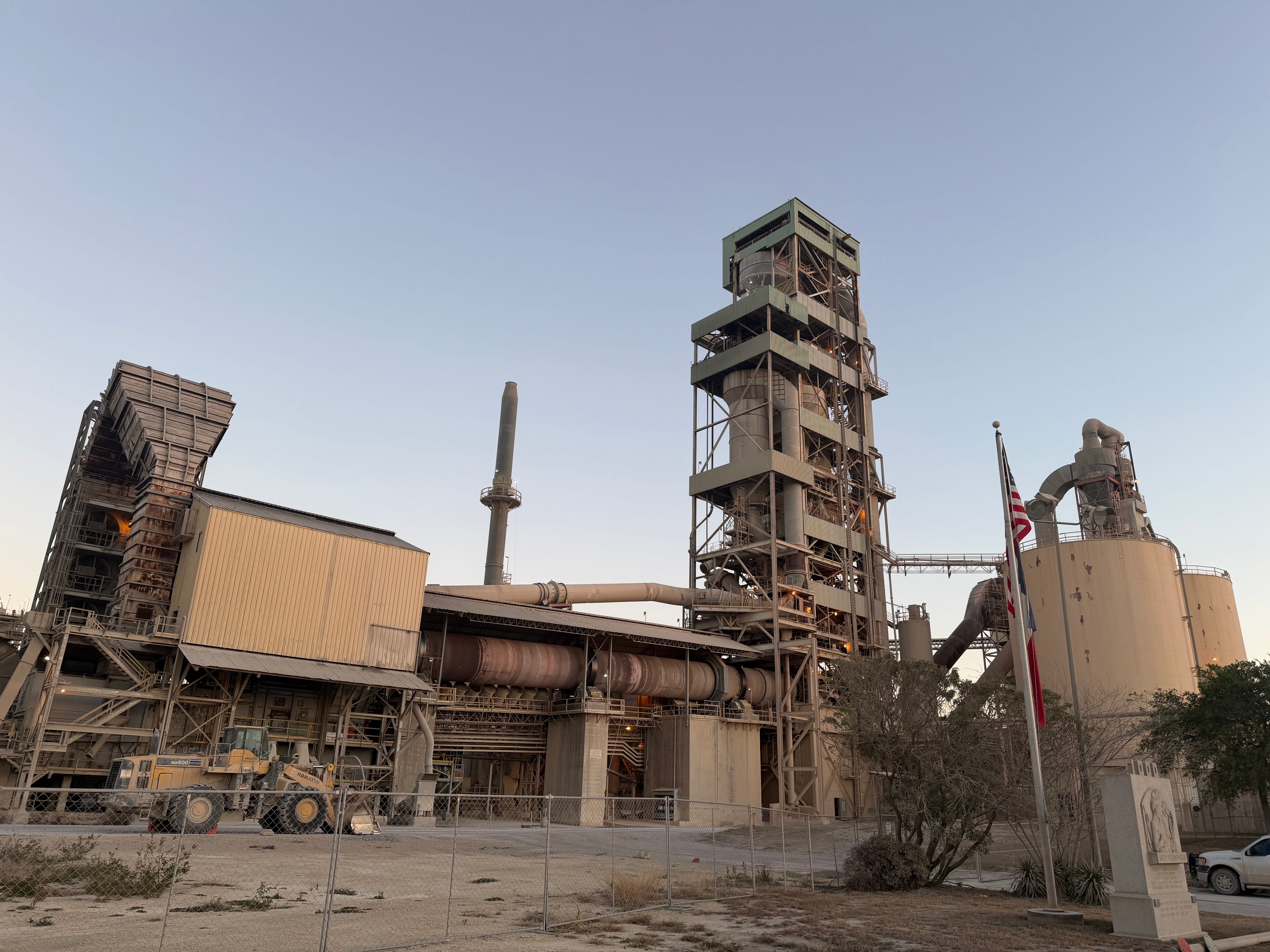
Last week I visited a cement plant. A couple of people had warned me in advance that it would be “dusty,” but that turned out to have been an understatement. A cement plant is essentially a machine for grinding up rocks, cooking rocks, and then grinding them up some more. All of this produces huge amounts of dust, which it is impossible to fully contain. There is a layer of dust on the ground, on every horizontal surface of every machine and piece of structure and roof, and as you step onto the site you feel the dust in your nose and your sinuses.
And then there is the noise, because grinding rocks (using three-inch iron balls in a giant sort of a tumble dryer) and cooking rocks (using a one-hundred-and-fifty-foot-long rotating kiln at 2,500F) are noisy. To go anywhere near all the machinery, you have to wear earplugs, with the result that your aural world shrinks to the space between your ears. You can only hear conversation if the other person is standing next to you and shouting.
It’s an alien environment—monochrome dust-grey, deafening, dangerous. It feels like a little piece of Mars.
It was fascinating.
My tour guide, whom we’ll call Ben, was the site supervisor. He had an encyclopedic understanding of how every part of this giant machine worked, and a shrewd psychological understanding of how every person tending to it worked, too. His role was to make sure that everything operated smoothly.
Towards the end of the tour, as we stood near one of the rock-crushing machines which had, mercifully, paused for a moment, I asked him what he loved about what he did.
“That’s easy,” he said. “The thing about this place is that the goalposts don’t move—every day, the job is about making sure we make a high-quality product. I like that. And then, every day I have to address any number of different challenges to get to that same goal. I like that, too.”
The cement plant was a different working environment than any I have ever seen, and I was absorbed by figuring out how it all worked and what it was like to work there. And Ben’s description of his job was very different from what many of us experience on a daily basis. Ben’s goalposts don’t move. Ours do, constantly—that is, if we have an idea of where they are in the first place.
I wrote in The Problem with Change about humans’ psychological need for stability in our workplaces—about our need for a reasonably predictable set of relationships, tools, resources, and goals, and about how when too much of this changes too often, it impairs our ability to do our best work. Stability of this sort allows us to figure out the best direction in which to point our efforts. Its opposite, instability—which, in a world of constant restructurings and layoffs and, today, AI mandates, is more the rule than the exception—can be paralyzing.
While Ben’s physical working environment, with all the noise and dust, is not one I suspect many of us would choose, his psychological environment—with a stable objective and yet myriad paths to that end—is one many of us would envy.
And that includes those of us who have formal goals at work, because strangely these sorts of goals work against the idea of stability.
Here’s why. Most goals are set fairly infrequently—they’re annual, say, or perhaps semi-annual or quarterly. They’re set this way because a) they’re an attempt to provide stability, and b) they’re an attempt to create alignment, so people need time to review them up and down the hierarchy to make sure they line up. Work, on the other hand, changes pretty much constantly. So goals, by the time they’re created and approved, are already outdated—they are already out of step with reality. They become something you shouldn’t do, or even something you can’t do, because the world has moved on. And yet, because they exist, your employer assumes it has given you all the stability of objective that you need, and so doesn’t think to ensure you get it another way.
The other way is simply a team leader who makes sure that you know how your work connects to the work beyond your team, week in and week out, as the work and the world change.
This isn’t an act of definition—defining your objectives—as much as it is an act of explanation. It’s enormously helpful to know what happened to the proposal you put together, or the deck you created, or the recommendation you made once it disappeared from view. It’s enormously valuable to understand how your efforts were received by others you might not hear from directly.
But we don’t teach team leaders to do this. The nature of large organizations is that work goes up the ladder, but that very often nothing comes back down, and so you don’t know if you made a difference. And it’s this sense that you made a difference that provides a measure of stability. Ben has this sense because his measure of difference—high-quality cement—doesn’t change. Those of us in offices only get this sense when someone takes the time to tell us what happened to our work.
Which is to say that, when the world is dynamic, the work must be too—and stability must come not from a fixed goal but from an ongoing conversation about the impact we each have. What we need is a sort of dynamic stability—like a plane in flight. Not standing still; not bouncing about all over the sky, either. We don’t need to know forever, but we do need to know now: cement plant or corporate office, goalposts moving or not, all of us want to understand how our efforts make a difference.
In addition to writing about work, I advise businesses around the world on leadership and people. If you’d like to explore how I can help your organization, please check out my website here.